Tag: Auto Loan

  • Subprime Auto Loans in Orange County

    Car buyers reviewing financing options with a salesperson at a dealership, illustrating subprime auto loans in Orange County at California Motors Direct.

    In Orange County, owning a car isn’t optional for most people—it’s essential. If your credit falls in the subprime range, getting approved for an auto loan is still very possible.

    The real risk isn’t approval—it’s ending up in a loan that quietly sets you back financially through high interest, long terms, and hidden trade-offs.

    This guide breaks down how subprime auto loans actually work, what OC buyers should realistically expect, and how to protect yourself—while still getting the car you need.

    A subprime auto loan typically applies to buyers with lower credit scores or limited credit history. “Subprime” doesn’t mean you’re irresponsible—it means lenders view your profile as higher risk, so they price the loan higher (APR), require more verification, and may limit terms.

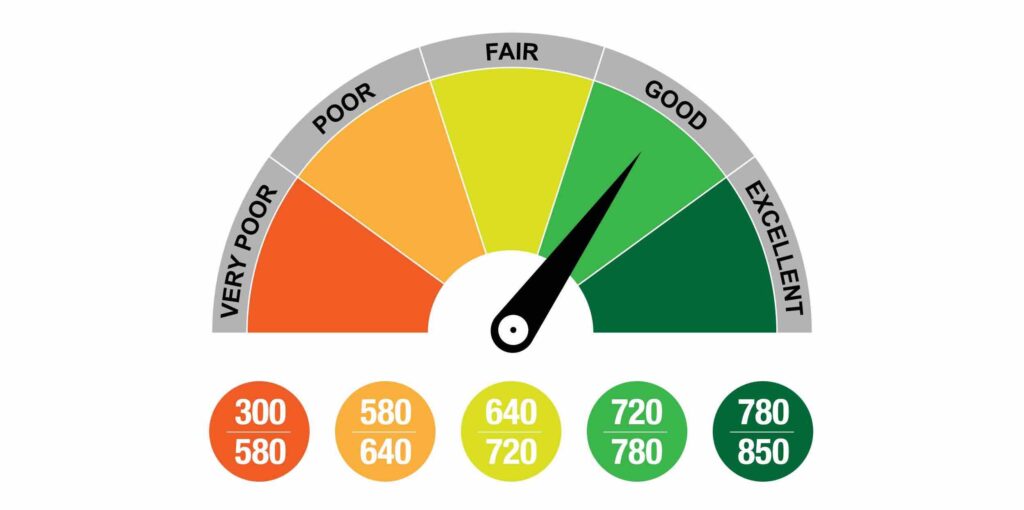
    In auto lending, “subprime” is often used as a broad category ranging credit scores from 300-600, but it’s commonly broken down further by credit tier. Based on VantageScore® 4.0, credit tiers generally fall into the following ranges:
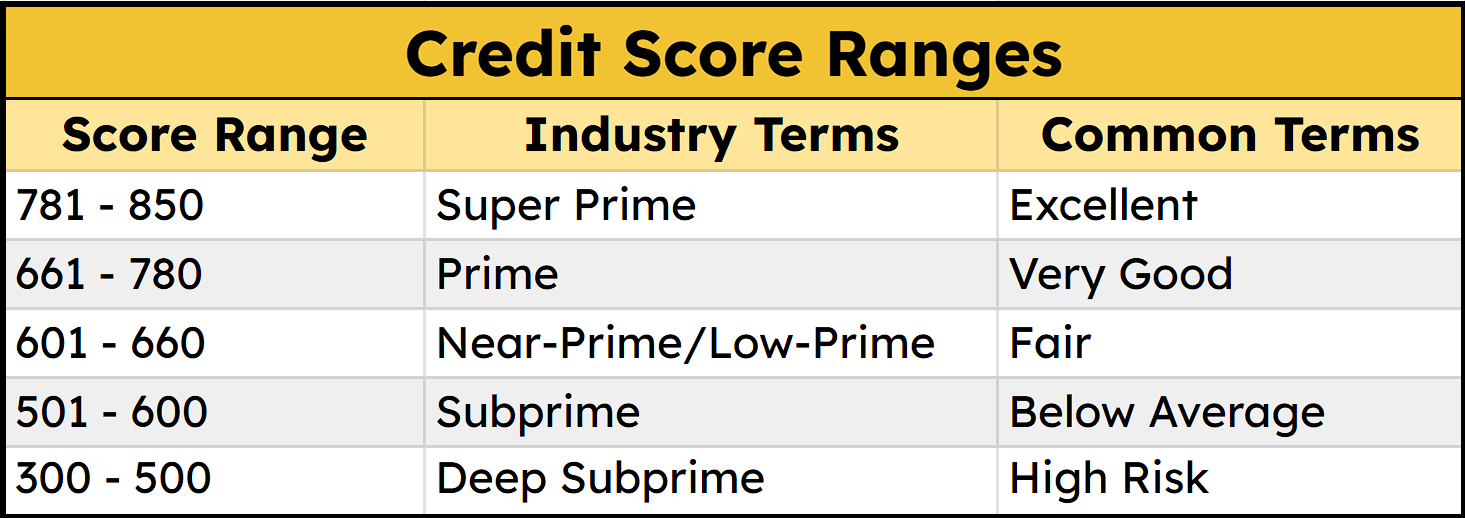
    A table listing credit score ranges from 300 to 850 with corresponding industry and common credit terms.

    Credit score tiers vary by lender, loan type, and scoring model. Ranges shown are approximate for educational purposes.

    Being subprime does not mean you can’t buy a reliable car or improve your situation—it simply means the loan structure matters more than ever.

    Many buyers naturally focus on the monthly payment. That’s understandable—but with subprime loans, the interest rate is often the biggest cost driver.

    • Subprime APRs are significantly higher than prime rates.
    • Auto loans are amortized, meaning early payments go mostly toward interest—which is especially costly when APRs are high.
    • Longer loan terms reduce the payment but dramatically increase total cost, especially at higher APRs.

    A difference of just a few percentage points in APR can mean thousands of dollars over the life of the loan—even if the monthly payment only changes slightly.

    For example, stretching a loan from 48 to 72 months at subprime APRs can add several thousand dollars in interest—even if the payment feels manageable on paper.

    📍 MORE: Learn more about how interest rates affect your monthly payments.

    Rates vary by lender and borrower profile, but it helps to anchor expectations with reputable market data.

    Experian’s reported average APRs by credit tier (VantageScore 4.0) show how sharply rates jump as credit drops.
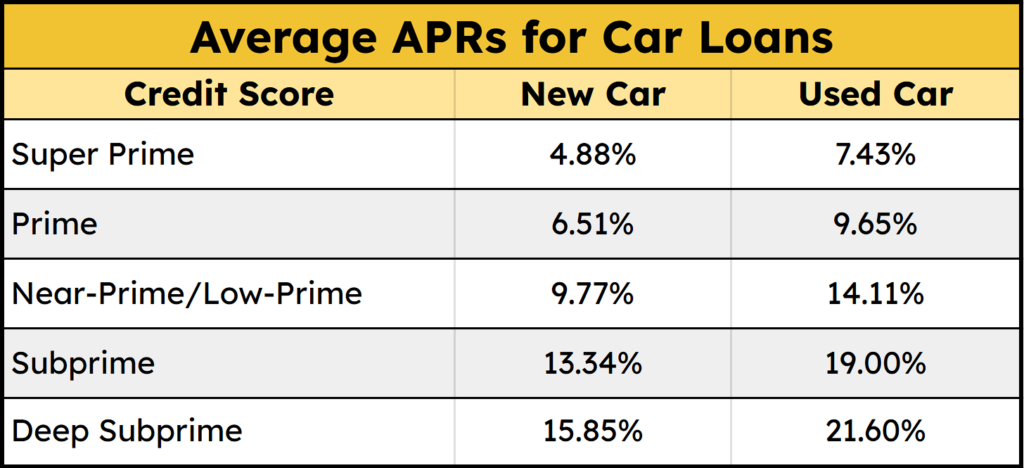
    Table showing average auto loan APRs by credit tier, including super prime, prime, near-prime, subprime, and deep subprime for new and used cars.

    Source: Experian State of the Automotive Finance Market, Q3 2025

    Notice how used-car APRs in subprime tiers can approach or even exceed 20%, where interest becomes a dominant portion of the total loan cost.

    Used vehicles typically carry higher APRs than new cars, and when combined with longer loan terms, this can significantly increase the total amount of interest paid.

    Avoiding these mistakes will put you ahead of most buyers:

    1. Shopping Only By Monthly Payment

    A low payment can hide a long loan term and excessive interest. Always look at:

    • APR
    • Loan Length
    • Total Amount Paid Over Time

    A dealer can make almost any car “fit” by stretching the term. A lower payment often means a higher total cost — especially at subprime APRs.

    2. Rolling Everything Into The Loan

    Optional add-ons like service contracts, GAP waivers, and other products are often financed as a lump sum and paid over the whole loan term—meaning you pay interest on them too. Some can be useful—but they should never be automatic.

    3. Taking the First Approval Without Comparing Options

    Even subprime buyers can often qualify with multiple lenders, and small APR differences can make a meaningful impact.

    With subprime loans, even a slight rate improvement can translate into real savings, so rate shopping is not optional, it is essential. In subprime financing, details matter — and small differences can cost thousands.

    📍 MORE: How to Own a Car With Bad Credit.

    Credit score matters, but approvals often hinge on your stability and your ability to repay.

    Common factors lenders look at include:

    • Income & job stability (consistent pay is powerful)
    • Debt-to-income (DTI) (how much of your income is already committed)
    • Down payment / loan-to-value (LTV) (more down = less lender risk)
    • Residence stability
    • Vehicle factors (age, mileage, and book value)

    Lenders are assessing risk, not judging you — the goal is to see whether the loan fits your financial reality.

    Car buyer reviewing financing documents highlighting income and debt factors lenders evaluate besides credit score.

    In Orange County, where rent and cost of living are high, showing stable income, manageable DTI, and even a modest down payment can significantly improve both approval odds and APR terms.

    Here’s the approach that consistently produces the best outcomes for subprime buyers:

    Step 1: Get Pre-Approved Before You Shop

    Even if you plan to finance at the dealer, a pre-approval will gives you:

    • A realistic rate baseline
    • A spending limit
    • Negotiation leverage

    Pre-approval doesn’t lock you in — it simply gives you a benchmark to compare against dealer offers.

    Auto loan approval process showing borrower signing financing documents with dealership finance representative.

    👉 Get pre-approved before you walk into the dealership — it changes the entire conversation.

    Step 2: Choose the Right Car, Not Just the Right Payment

    Subprime buyers should prioritize vehicles that reduce lender risk and avoid costly repairs.

    The car you choose directly affects your approval, interest rate, and long-term ownership cost.

    Strong general targets:

    • Reliable, widely available models (lower repair costs and easier approvals)
    • Clean-title vehicles with verifiable history
    • Models with widely available parts/repair support
    • Lower mileage (reduces lender risk and future repair exposure)

    📍 MORE: Best Reliable, Budget-Friendly SUVs for Subprime Buyers.

    Step 3: Set Guardrails, Not Just a Goal

    Before you start shopping, set clear financial limits so you know exactly what you can afford and avoid stretching your budget.

    • Loan Term: What’s the longest you’re willing to finance? (avoid 84 months if possible)
    • Monthly Payment: What can you comfortably afford each month?
    • Total Budget: Your true budget isn’t just the loan — it’s the total cost of owning the car.
      • Insurance
      • Fuel
      • Maintenance

    Setting these guardrails before you shop helps you stay in control of the deal — instead of letting the deal define your budget.

    A subprime loan doesn’t have to be permanent — the goal is to use it as a stepping stone to better terms.

    The Fastest Levers You Can Pull:

    • Put more down (even $500–$2,000 can change LTV and terms)
    • Choose a cheaper car (borrowing less saves interest on every payment)
    • Shorten the term when possible (less time = less interest)
    • Add a qualified co-signer (only if it’s a solid, trusted agreement)
    • Refinance after 6–18 months if you’ve made consistent on-time payments and your credit profile has improved

    Even a modest refinance can significantly reduce your remaining interest and lower your monthly payment.

    📍 MORE: Contact Us to review your options and see what you may qualify for — including whether refinancing could lower your rate over time.

    Buying a car with subprime credit isn’t about finding any approval — it’s about making a smart decision that sets you up for better terms over time.

    Focus on the total cost, choose the right vehicle, and structure your loan with intention. Small decisions today can make a big difference in what you pay — and how quickly you improve your situation.

    👉 Take your time, ask the right questions, and make sure the deal works for you — not just now, but long-term.
  • What Credit Score Do You Need to Buy a Car in California?

    Image with title and credit score rating graphic

    Whether you’re buying your first car or upgrading to a newer model, understanding how your credit score affects your ability to finance a vehicle in California is essential. Your credit score doesn’t just determine whether you get approved—it also impacts your interest rate, down payment, and loan terms.

    Let’s walk through everything you need to know about credit scores and car buying in California—what’s considered a good score, what you can qualify for at different levels, and how to improve your financial standing before applying for a loan.

    Your credit score is a three-digit number that tells lenders how reliable you are at repaying borrowed money. In the eyes of banks, credit unions, and finance companies, your score reflects your financial behavior.

    Lenders group credit scores into different tiers, and these tiers affect the interest rate you’ll receive. Higher credit scores signal that you’re a low-risk borrower. As a result, lenders will likely offer you:

    • Lower interest rates
    • More flexible loan terms
    • Lower down payment requirements
    • Approval for higher vehicle price ranges

    On the other hand, if your score is lower, you may still get approved—but expect less favorable terms and higher monthly payments.

    There’s no official minimum credit score to buy a car in California. However, here’s what most buyers can expect based on their credit:

    Good Credit (661 and above)

    credit score range showing arrow pointing at good credit score

    If your score is 661 or higher, you’re in a favorable position and will likely qualify for the lowest available interest rates. Many buyers in this range secure financing without needing a large down payment and have access to new cars, certified pre-owned vehicles, and promotional offers.

    ⚠️ Fair Credit (600–660)

    Between 600 and 660, you can still qualify for financing, but lenders may see you as a moderate risk. Expect higher rates and possibly a requirement for a larger down payment. You may have fewer options when it comes to loan terms or vehicle selection.

    • Loan Approval: Possible, with higher APR
    • Interest Rates: Moderate to high
    • Down Payment: Often required
    • Best For: Reliable used cars or entry-level new vehicles

    Bad Credit (below 600)

    Even with a credit score under 600, you can still qualify for financing—particularly in California, where many lenders and dealerships offer programs tailored for credit-challenged buyers. However, interest rates will be significantly higher, and you’ll often need to make a substantial down payment to secure a loan.

    • Loan Approval: Possible through subprime lenders
    • Interest Rates: Very high
    • Down Payment: Typically required (10%–20%)
    • Best For: Budget used cars, “Buy Here Pay Here” lots, or special financing programs

    MORE: How to Buy a Car with Bad Credit

    Your credit score doesn’t just determine whether you’ll get approved for a car loan—it plays a major role in how much you’ll pay every single month. Even a difference of 50–100 points in your score can lead to thousands of dollars in savings or added cost over the life of the loan.

    a person adding a card to their car payment

    Let’s break it down using a $25,000 loan financed over 60 months (5 years):

    661 and Above (Good to Excellent Credit)

    With a top-tier credit score, you’re likely to qualify for the lowest available interest rates, often between 4% and 6% (depending on the lender and vehicle).

    • Estimated APR: 5.0%
    • Monthly Payment: Around $472
    • Total Interest Paid: Approximately $3,320 over 5 years

    This gives you the power and flexibility to negotiate better terms, choose from more lenders, and potentially put less money down while still enjoying affordable payments.

    ⚖️ 600–660 (Fair to Moderate Credit)

    With a mid-range credit score, you’re not considered high-risk, but you may still face moderate interest rates—typically between 8% and 12%, depending on the lender.

    • Estimated APR: 9.5%
    • Monthly Payment: Around $525
    • Total Interest Paid: Approximately $6,500

    Here, you’re still in a position to qualify for traditional auto loans, but the cost of borrowing is noticeably higher. Over five years, you could pay about double the interest compared to someone with a score of 661 or higher.

    Below 600 (Poor Credit)

    When your credit dips below 600, lenders typically consider you a higher-risk borrower, which means steep APRs ranging from 15% to 20% or more.

    • Estimated APR: 16.0%
    • Monthly Payment: $608
    • Total Interest Paid: $11,480

    That’s more than $8,000 in extra interest compared to someone with a strong credit score. In many cases, lenders may also require a larger down payment, proof of steady income, or a co-signer.

    MORE: What to Know Before Committing to a Used Car

    If you have no credit history—meaning you’ve never used a credit card or taken out a loan—you’re considered an “unscorable” borrower. Lenders won’t have any data to predict your repayment behavior. Still, this doesn’t automatically disqualify you from getting a loan.

    In California, many dealerships and credit unions offer first-time buyer programs tailored to individuals with no credit. These programs often require:

    • Proof of steady income
    • Verification of employment
    • A larger down payment
    • Possibly a co-signer with stronger credit

    MORE: Explore Additional Tips on Purchasing with No Credit History

    Improving your credit score—even by 20 to 40 points—can open the door to better rates and bigger savings. Here are five steps you can take:

    graphic showing a person increasing their credit score and being free

    1. Check Your Credit Report for Errors

    Visit AnnualCreditReport.com and review your report from all three major bureaus. Dispute any inaccurate information, especially missed payments or incorrect account balances.

    2. Pay Down Revolving Debt

    Credit utilization accounts for about 30% of your credit score. Aim to keep your usage under 30%, and under 10% if you want optimal results. Paying down credit cards can boost your score quickly.

    3. Make Payments on Time

    On-time payment history is the most important factor in your score. It makes up about 35% of your credit score. Set up autopay for credit cards and loans to avoid late payments.

    4. Avoid New Credit Applications

    Every new credit inquiry can temporarily drop your score. Avoid opening new accounts in the months leading up to your car purchase.

    5. Build Credit Strategically

    Consider a secured credit card or a credit-builder loan from a credit union to demonstrate responsible borrowing habits.

    Dealership Financing

    california motors direct

    Most car dealerships work with a network of lenders—including banks, credit unions, and specialized auto finance companies. This makes it easy to compare multiple offers in one place. Some dealerships also have special finance departments that focus on helping buyers with bad credit or no credit history.

    Credit Unions

    Local institutions like Golden 1 Credit Union, SchoolsFirst FCU, or Navy Federal tend to offer lower interest rates than big banks. They often have more flexible lending criteria and may be more willing to work with moderate credit scores.

    Online Lenders

    Platforms like Capital One Auto Navigator, Carvana, and AutoPay let you pre-qualify for financing online—without affecting your credit. This gives you a clear idea of your budget before you even step into a dealership.

    Buy Here Pay Here Dealerships

    These lots finance customers directly, without involving outside banks. They typically approve almost anyone, regardless of credit score. However, interest rates are often very high, and some may not report payments to credit bureaus—limiting your ability to rebuild credit.

    Always read the fine print and ask questions before committing to any financing offer.

    While your credit score can impact your loan options, the good news is that you don’t need a perfect credit to drive off in the car you need. California offers flexible programs for buyers across all credit tiers, and with a little preparation, you can position yourself to get better rates and more choices.

    If your score is already strong, use that to your advantage by comparing multiple lenders and negotiating terms. If you’re rebuilding or starting from scratch, focus on progress and work with dealerships or credit unions that understand your situation.

    Every on-time payment after you purchase will help strengthen your credit for the future.